

As a supplier of Ring Main Three Phase Pad Mounted Transformers, I'm often asked about how these remarkable pieces of electrical equipment work. In this blog post, I'll take you through the inner workings of a Ring Main Three Phase Pad Mounted Transformer, explaining the key concepts and components that make it an essential part of modern electrical distribution systems.
Basic Principles of Transformers
Before delving into the specifics of Ring Main Three Phase Pad Mounted Transformers, it's important to understand the fundamental principles of transformers. A transformer is a static electrical device that transfers electrical energy between two or more circuits through electromagnetic induction. It consists of two or more coils of wire, known as windings, which are wound around a common magnetic core.
The basic operation of a transformer is based on Faraday's law of electromagnetic induction. When an alternating current (AC) flows through the primary winding, it creates a changing magnetic field in the core. This changing magnetic field induces a voltage in the secondary winding, which is proportional to the ratio of the number of turns in the secondary winding to the number of turns in the primary winding. This ratio is known as the turns ratio, and it determines the voltage transformation capability of the transformer.
Three - Phase Systems
Three - phase power is widely used in industrial and commercial applications due to its efficiency and ability to deliver large amounts of power. A three - phase system consists of three alternating currents that are out of phase with each other by 120 degrees. This provides a more constant and balanced power supply compared to single - phase systems.
In a three - phase transformer, there are three primary windings and three secondary windings, each corresponding to one of the three phases. The windings are usually connected in either a delta or a wye configuration. The delta connection is used when a high - current, low - voltage output is required, while the wye connection is often used for step - down transformers and for grounding purposes.

Ring Main Configuration
The ring main configuration is a common setup in electrical distribution systems that provides a high level of reliability. In a ring main system, the power is supplied from multiple sources, and the transformers are connected in a closed loop or ring. This allows for the continuous supply of power even if one part of the ring fails.
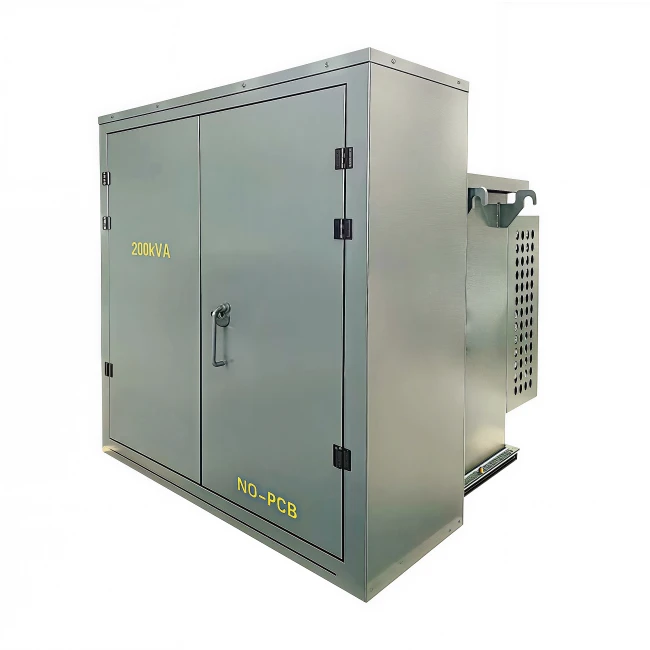
A Ring Main Three Phase Pad Mounted Transformer is designed to be part of this ring main system. It is typically installed at a convenient location, such as on a concrete pad, close to the load it serves. The transformer is connected to the ring main cables through high - voltage terminations and is isolated from the surrounding environment in a weather - proof and tamper - proof enclosure.
Key Components of a Ring Main Three Phase Pad Mounted Transformer
Magnetic Core
The magnetic core of a transformer is usually made of laminated silicon steel. The laminations reduce eddy current losses, which are caused by the circulating currents induced in the core. The core provides a low - reluctance path for the magnetic flux, which is essential for efficient energy transfer between the primary and secondary windings.
Windings
The primary and secondary windings are made of copper or aluminum conductors. The choice of conductor material depends on various factors such as cost, conductivity, and mechanical strength. The windings are insulated to prevent short - circuits and to ensure safe operation. For more information on high - quality insulation, you can check out our H Class Insulation Three Phase Pad Transformer.
Insulation System
The insulation system of the transformer is crucial for its performance and longevity. It protects the windings from electrical breakdown and helps to dissipate heat. The insulation materials used can include paper, oil, or synthetic materials. An Oil Immersed Three Phase Pad Mounted Transformer uses oil as an insulating and cooling medium, which provides excellent heat dissipation and electrical insulation properties.
Cooling System
Transformers generate heat during operation due to losses in the windings and the core. A proper cooling system is required to maintain the temperature of the transformer within safe limits. In oil - immersed transformers, the oil acts as a coolant, transferring heat from the windings and the core to the tank walls, where it is dissipated to the surrounding air. Some transformers may also be equipped with additional cooling devices such as radiators or fans.
High - Voltage and Low - Voltage Terminations
The high - voltage and low - voltage terminations are used to connect the transformer to the incoming and outgoing electrical cables. These terminations are designed to provide a safe and reliable electrical connection while protecting the transformer from environmental factors such as moisture and dust.
Protection Devices
Ring Main Three Phase Pad Mounted Transformers are equipped with various protection devices to ensure safe and reliable operation. These may include over - current relays, over - voltage relays, and temperature sensors. These devices monitor the operating conditions of the transformer and trip the circuit breakers in case of abnormal conditions, such as a short - circuit or an over - temperature situation.
How It Works in a Distribution System
When power is supplied to the primary windings of the Ring Main Three Phase Pad Mounted Transformer through the ring main cables, an alternating magnetic field is created in the core. This magnetic field induces a voltage in the secondary windings, which is then supplied to the load.
The ring main configuration allows for the flexibility of power supply. If one source of power fails, the power can be rerouted through the ring to ensure continuous supply to the load. The transformer steps down the high - voltage power from the distribution network to a lower voltage level that is suitable for use by the end - users.
For example, a 1500 Kva 11kv 22kv 33kv Pad Mount Transformer can step down the voltage from 11kV, 22kV, or 33kV to a lower voltage, such as 400V, which is commonly used in commercial and industrial applications.
Advantages of Ring Main Three Phase Pad Mounted Transformers
- Reliability: The ring main configuration provides a high level of reliability, as power can be rerouted in case of a failure.
- Safety: The pad - mounted design and the use of protection devices ensure the safety of the transformer and the surrounding environment.
- Flexibility: These transformers can be easily integrated into existing distribution systems and can be customized to meet specific requirements.
- Efficiency: The use of high - quality materials and advanced design techniques ensures high efficiency and low losses.
Contact for Procurement
If you are interested in purchasing a Ring Main Three Phase Pad Mounted Transformer for your electrical distribution system, we are here to help. Our team of experts can provide you with detailed information about our products, including specifications, pricing, and installation guidelines. We offer a wide range of transformers to meet your specific needs, and we are committed to providing high - quality products and excellent customer service. Don't hesitate to contact us for procurement and further discussion.
References
- Electric Power Systems by J. Arrillaga and N.R. Watson
- Power System Analysis and Design by J. Duncan Glover, M. Stanley Sarma, and Thomas J. Overbye
- Transformers: Principles, Applications, and Maintenance by Robert C. Dorf and Charles K. Alexander