

Pole Mounted Transformer
VKE: Leading Pole Mounted Transformer Manufacturer
Founded in 2003, Jiangsu VKE Transformer Co., Ltd. is a professional manufacturer of high-quality compact substation. Our facility adopts a full-process layout that seamlessly connects each step - from raw materials to finished products - to achieve a smooth workflow. We are committed to becoming your trusted partner.


Why Choose Us
Quality Assurance
VKE employs industry-leading automated testing systems to conduct full life-cycle monitoring for every transformer. The combination of precision instruments and digital platforms ensures that our products meet strict quality standards and custom requirements.
One-Stop Service
VKE ensures that every transformer we deliver undergoes rigorous quality checks. We offer a one-stop service, including quotation, manufacturing, installation, commissioning, and training.
Production Capacity
With two production bases covering 33,660 m² and a dedicated team of 110+ employees, we achieve an annual production capacity of 6,000 MVA.
Global Certification
We are IEC, CE, UL and regional safety certified. With high-performance products and top-quality service, our products are sold in many countries and regions worldwide.
Types of Pole Mounted Transformer
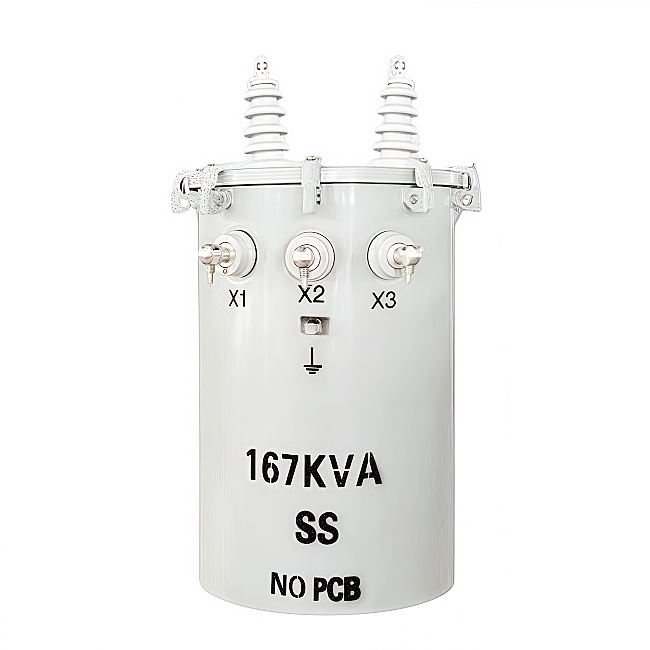
Overhead Pole-mounted Single-phase Transformer
Overhead pole-mounted single-phase transformer is a cylindrical design with small size and low manufacturing cost, and is widely used in European and American countries.
12470y 7200 120 240v Pole Mounted Transformer
12470Y/7200 120/240V pole mounted transformer needs to be equipped with a pressure relief valve. The purpose is to control the pressure stability inside the transformer.
100 Kva Single Phase Pole Mounted Transformer
100 kva single phase pole mounted transformer is an ideal choice for rural areas and single-phase high-power power consumption scenarios.
75 Kva Pole Mounted Transformer
75 kva pole-mounted transformer, with its economy and practicality, is widely used in urban and rural distribution networks and is an important device for ensuring reliable power supply to low-voltage users.
Oil-immersed Pole Transformer
Oil-immersed pole transformers are outdoor power distribution equipment installed on utility poles or cement poles. In order to achieve insulation, heat dissipation and moisture resistance, the transformer winding is directly immersed in mineral oil.
Single Phase Pole Mounted Transformer
Single phase pole mounted transformers are the core equipment of single-phase distribution networks. They achieve the conversion from medium voltage to low voltage through a simple structure, providing stable power for small users
Technical Specifications
|
Frequency |
60Hz / 50Hz |
|
Temperature Rise |
Generally 55°C / 65°C |
|
Core |
C.R.G.O (Cold Rolled Grain Oriented) / Core & Amorphous Core |
|
Winding Material |
Cu-Cu / Cu-Al / Al-Al |
|
Tap Range |
±5% In 2.5% increments (4 tap positions: +2, +1, 0, -1, -2) |
|
Product Scope |
5 kVA – 167 kVA |
|
Primary Voltage |
2400V to 19920V |
|
Secondary Voltage |
120V to 600V |
|
Insulation Class |
Typically Class A or B (consult spec sheet for precise class) |
|
Impedance Range |
Usually 2% to 6% depending on size |
|
BIL (Basic Impulse Level) |
95kV (typical for 15kV class), varies with voltage rating |
Advantages of Pole Mounted Transformer
Enhanced Protection
The elevated positioning of pole-mounted transformers on utility poles provides enhanced protection against flooding and vandalism, and reduces the risk of accidents involving pedestrians or vehicles.
Space-Saving Design
By utilizing existing utility poles, there is no need for additional ground space for transformer installations. This is particularly advantageous in urban areas where land availability is limited.
Cost-Effectiveness
They are generally less expensive to install and maintain compared to pad-mounted or underground alternatives. Their elevated position facilitates easier access for utility workers during maintenance and repair activities.
Improved Cooling Capabilities
The exposed position allows for natural air circulation, which aids in dissipating heat more efficiently. This can enhance the performance and extend the lifespan of the transformer.
Versatility
Pole-mounted transformers can be easily relocated or replaced if necessary, providing flexibility in the design and maintenance of electrical distribution systems.
Application of Pole Mounted Transformer
Urban/Suburban Neighborhoods: In cities and suburbs, pole mounted transformers are installed on utility poles to step down medium-voltage electricity (e.g., 11 kV or 33 kV) to the low-voltage levels (240V/120V) required for homes and small businesses.
Rural Areas: Pole mounted transformers are frequently used in rural or less densely populated areas where underground cables are not practical due to cost. Long stretches of utility poles deliver power over large distances.
Commercial Buildings: Small commercial establishments like shops, offices, and restaurants may rely on pole mounted transformers for their electricity supply if located in areas where overhead distribution is standard.
Farms and Agricultural Facilities: In agricultural areas, farms often use pole-mounted transformers to supply power to equipment, irrigation systems, and other farm-related facilities.
Construction Sites: Pole mounted transformers can provide temporary power at construction sites or temporary facilities where overhead power lines exist or can be installed quickly.
Street Lighting and Public Infrastructure: Pole mounted transformers often supply power to street lights and public lighting systems along roads, highways, and other public infrastructure.
Understanding the Distinctions Between Pole-Mounted and Pad-Mounted Transformers
Here’s a side-by-side comparison of the key differences between pole-mounted and pad-mounted transformers:
|
Aspect |
Pole-Mounted Transformers |
Pad-Mounted Transformers |
|
Installation Location |
Utility Poles |
Concrete Pads or Enclosures |
|
Accessibility |
Easier to access for maintenance |
Ground-level installation, may require less maintenance effort |
|
Cost |
Generally, more cost-effective |
Slightly higher installation and unit cost |
|
Space Efficiency |
Require more space |
Compact and space-efficient |
|
Visual Impact |
Because of the utility poles required, they are more of an eye sore if the other utilities are buried |
May blend better in certain areas |
The pole-mounted transformer should be installed as close to the load center as possible to reduce the line power loss and line voltage drop of the low-voltage power supply line. Installing in complex poles such as corner poles and branch poles should be avoided.
It is recommended to keep the transformer profile at least 5m away from combustible buildings and to keep it at least 3m away from fire-resistant buildings. There should be a minimum distance of 5m between the substation and the ground and a minimum distance of 1m between the low-voltage distribution box and the ground.
All exposed live parts on the transformer platform should be at least 5m above the ground, and warning signs should be set up in obvious locations 2.5 to 3.0m above the ground.
When high and low voltage lines are installed on the same pole, the low voltage line should be located below the high voltage line, and the distance between the high and low voltage cross arms should not be less than 20m.
In areas where the air contains flammable or explosive gases or dust that can destroy insulation, it is not advisable to install pole-mounted substations and indoor substations should be used instead.

Our Quality Control Process
Raw Material Test
At VKE, we place great emphasis on the quality of raw materials, as they are the foundation of reliable and high-performance products. We have strict requirements for all incoming materials, including aluminum, copper, insulation materials, and outer sheath compounds. Before any material enters the production line, it must pass a full range of quality tests conducted by our in-house technical team.
Progress Test
VKE has a dedicated team to follow up on in-process testing during manufacturing. All tests will be conducted as follows:
1. Coil winding process inspection
2. Coil insulation inspection
3. Core assembly inspection
4. Coil and core set inspection
5. Drying process detection (vacuum drying or hot air drying)
6. Oil filling process inspection (applicable to oil-immersed transformers)
7. Intermediate electrical performance test (as needed)
8. Assembly process inspection
Routine Test Before Shippment
Ensure that the transformer has no physical defects, such as damage, scratches, or leaks. Nameplate data, external parts, and physical condition of the transformer. Verify that the voltage ratio between the primary and secondary windings is correct, ensuring the transformer’s voltage conversion is accurate.
Customization Process
Consultation and Contact
Reach out to us via email, phone, or our website to discuss your specific requirements and project goals.
Design Confirmation
We will create a basic design plan based on your requirements and confirm the specific design details with you.
Quotation and Agreement
Provide a detailed quotation, discuss, and sign the mutual agreement to finalize the project details.
Payment Confirmation
Make the payment to confirm the development project. 30% deposit in advance, 70% balance against the copy of B/L..
Manufacturing
We start the manufacturing process and oversee progress to ensure timely production. This helps us maintain efficiency and meet deadlines.
Logistics and Delivery
Together, we conduct the final acceptance to verify that the transformer meet your quality standards and requirements. By doing so, we ensure everything aligns with your expectations.
Shipping and Delivery
|
Payment Terms |
We accept LC, T/T,Western Union, PayPal and so on. If others, we can discuss. |
|
Delivery Time |
Usually it will take about 30 days after order confirmed. |
|
Package |
For the small capacity, we will use carton, but for big capacity, we should use strong wooden case for protection. |
|
Transportation |
For small package, we will send it by Express, such as DHL,FedEx,,UPS,TNT,EMS. For big package, we will sent you by sea , air or train. |
Our Certificates


FAQ
We're professional pole mounted transformer manufacturers and suppliers in China, specialized in providing high quality customized products. We warmly welcome you to buy pole mounted transformer for sale here from our factory. For price consultation, contact us.
Overhead Pole mounted Single phase Transformer, Oil immersed Pole Transformer, Single Phase Pole Mounted Distribution Transformer