

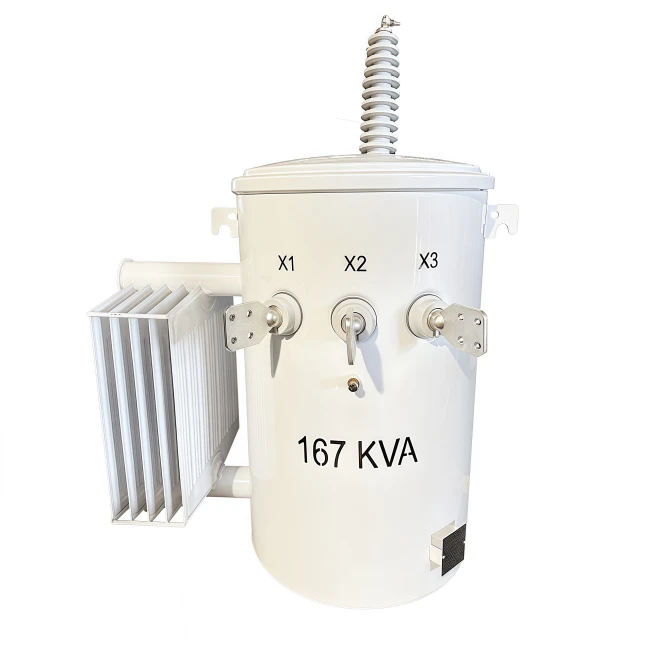
As a seasoned supplier of Oil-immersed Pole Transformers, I've witnessed firsthand the pivotal role these transformers play in electrical distribution networks. In this blog, I'll delve into the electrical characteristics of Oil-immersed Pole Transformers, shedding light on their features, advantages, and applications.
1. Basic Electrical Principles
Oil-immersed Pole Transformers operate based on the fundamental principles of electromagnetic induction. When an alternating current (AC) flows through the primary winding, it creates a changing magnetic field. This magnetic field then induces a voltage in the secondary winding, allowing for the transformation of electrical energy from one voltage level to another. The ratio of the number of turns in the primary and secondary windings determines the voltage transformation ratio.
2. Voltage Ratings
One of the key electrical characteristics of Oil-immersed Pole Transformers is their voltage ratings. These transformers are typically designed to step down high-voltage electricity from the power grid to a lower voltage suitable for residential, commercial, and industrial use. Common primary voltage ratings for pole-mounted transformers range from 2.4 kV to 34.5 kV, while secondary voltage ratings are usually 120/240 V for single-phase applications or 208Y/120 V, 480Y/277 V for three-phase applications.
3. Power Ratings
Power rating is another crucial aspect of Oil-immersed Pole Transformers. It indicates the maximum amount of electrical power that the transformer can handle safely and efficiently. Power ratings for pole-mounted transformers can vary widely, from as low as 10 kVA for small residential applications to several hundred kVA for larger commercial and industrial installations. When selecting a transformer, it's essential to choose a power rating that can meet the current and future load requirements of the electrical system.
4. Impedance
Impedance is a measure of the opposition to the flow of alternating current in a transformer. It plays a vital role in determining the short-circuit current and voltage regulation of the transformer. Oil-immersed Pole Transformers typically have a relatively low impedance, which allows for efficient power transfer and minimizes voltage drops under normal operating conditions. However, a low impedance also means that the transformer can experience high short-circuit currents during a fault, which requires proper protection devices to be installed.
5. Efficiency
Efficiency is an important consideration when evaluating the performance of Oil-immersed Pole Transformers. It is defined as the ratio of the output power to the input power, expressed as a percentage. High-efficiency transformers can reduce energy losses and operating costs over the long term. Modern Oil-immersed Pole Transformers are designed to achieve high levels of efficiency, typically ranging from 95% to 99%. Factors such as core material, winding design, and insulation quality can all affect the efficiency of the transformer.
6. Temperature Rise
Temperature rise is a critical parameter that affects the lifespan and reliability of Oil-immersed Pole Transformers. When a transformer is in operation, it generates heat due to the losses in the core and windings. The temperature rise of the transformer is the difference between its operating temperature and the ambient temperature. Excessive temperature rise can cause the insulation materials to degrade, leading to premature failure of the transformer. To ensure safe and reliable operation, Oil-immersed Pole Transformers are designed to limit the temperature rise to within acceptable limits, typically around 55°C to 65°C above the ambient temperature.
7. Dielectric Strength
The dielectric strength of the insulating oil is an important electrical characteristic of Oil-immersed Pole Transformers. The insulating oil serves several functions, including providing electrical insulation, cooling the transformer, and preventing the formation of corona and arcing. The dielectric strength of the oil determines its ability to withstand high voltages without breaking down. Regular testing of the insulating oil is essential to ensure its dielectric strength remains within acceptable limits.

8. Noise Level
Noise level is another factor to consider when installing Oil-immersed Pole Transformers, especially in residential and commercial areas. The noise generated by a transformer is primarily due to the magnetostriction of the core laminations and the vibration of the windings. Modern Oil-immersed Pole Transformers are designed to operate quietly, with noise levels typically ranging from 50 dB to 60 dB. However, factors such as the transformer's size, load, and installation environment can all affect the noise level.
9. Applications
Oil-immersed Pole Transformers are widely used in various electrical distribution applications, including:
- Residential Areas: They are commonly used to supply electricity to single-family homes, apartment buildings, and small commercial establishments.
- Commercial and Industrial Areas: These transformers are used to power shopping centers, offices, factories, and other industrial facilities.
- Rural and Remote Areas: Oil-immersed Pole Transformers are often the preferred choice for rural and remote areas where underground power distribution is not feasible.
10. Advantages
Oil-immersed Pole Transformers offer several advantages over other types of transformers, including:
- High Efficiency: They can achieve high levels of efficiency, which helps to reduce energy losses and operating costs.
- Reliability: The use of insulating oil provides excellent electrical insulation and cooling, which enhances the reliability and lifespan of the transformer.
- Compact Design: Oil-immersed Pole Transformers have a relatively compact design, making them suitable for installation in limited space.
- Easy Installation and Maintenance: They are easy to install on poles and require minimal maintenance.
Conclusion
In conclusion, Oil-immersed Pole Transformers are essential components of electrical distribution networks, offering reliable and efficient power transfer. Understanding their electrical characteristics, such as voltage ratings, power ratings, impedance, efficiency, temperature rise, dielectric strength, noise level, and applications, is crucial for selecting the right transformer for your specific needs. As a supplier of Oil-immersed Pole Transformers, we are committed to providing high-quality products that meet the highest industry standards. If you're interested in learning more about our products or have any questions regarding Oil-immersed Pole Transformers, please feel free to [initiate a conversation with us to discuss your procurement needs]. We look forward to working with you to find the best solutions for your electrical distribution requirements.
References
- Electric Power Systems: Analysis and Design by J. Duncan Glover, Mulukutla S. Sarma, and Thomas J. Overbye
- Transformer Engineering: Design, Technology, and Diagnostics by G. S. Sidhu