

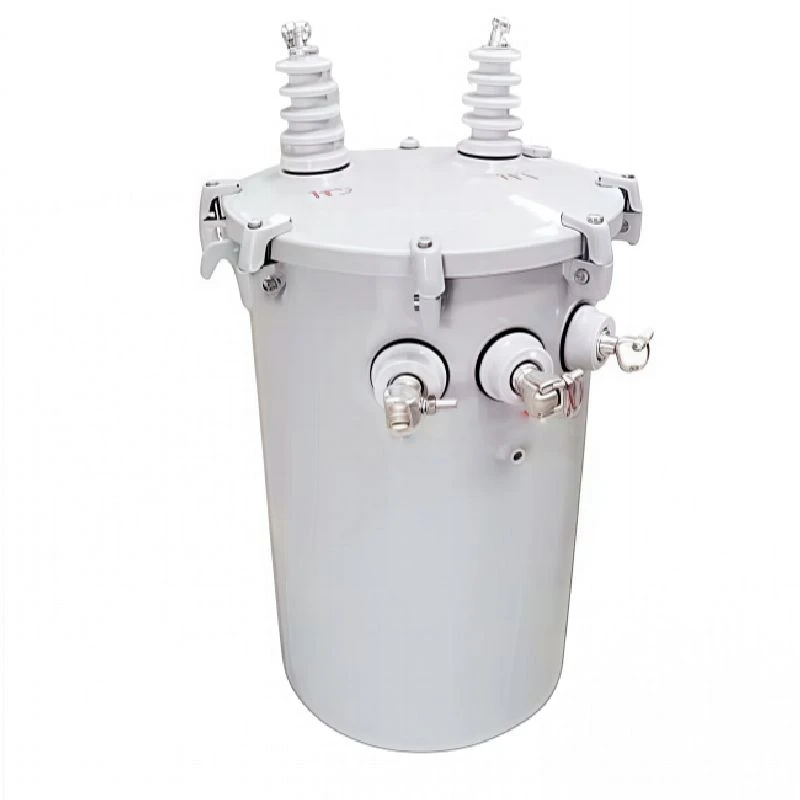
As a supplier of oil-immersed pole transformers, I've witnessed firsthand the critical role that over-current protection plays in ensuring the safety and longevity of these essential electrical assets. In this blog post, I'll delve into the intricacies of how over-current protection works on an oil-immersed pole transformer, exploring the underlying principles, components, and mechanisms that safeguard these transformers from the potentially damaging effects of excessive current.
Understanding Over-Current in Oil-Immersed Pole Transformers
Before we dive into the details of over-current protection, it's important to understand what over-current is and why it poses a threat to oil-immersed pole transformers. Over-current occurs when the current flowing through a circuit exceeds its rated capacity. This can happen due to a variety of reasons, including short circuits, ground faults, overloads, or equipment malfunctions.
In an oil-immersed pole transformer, over-current can have several detrimental effects. Excessive current can cause the transformer windings to overheat, leading to insulation damage and potentially causing a short circuit. It can also cause the transformer core to saturate, which can result in increased losses, reduced efficiency, and even damage to the transformer's magnetic components. Additionally, over-current can cause mechanical stress on the transformer's internal components, leading to physical damage and potentially causing the transformer to fail.
The Role of Over-Current Protection
The primary role of over-current protection in an oil-immersed pole transformer is to detect and interrupt excessive current before it can cause damage to the transformer. By quickly isolating the transformer from the fault, over-current protection helps to prevent further damage to the transformer and the electrical system as a whole. It also helps to ensure the safety of personnel working on or near the transformer by reducing the risk of electrical shock and fire.
Components of Over-Current Protection Systems
Over-current protection systems for oil-immersed pole transformers typically consist of several key components, each of which plays a specific role in detecting and interrupting excessive current. These components include:
Fuses
Fuses are one of the most common types of over-current protection devices used in oil-immersed pole transformers. A fuse is a simple device that consists of a metal wire or strip that melts when the current flowing through it exceeds a certain value. When the fuse melts, it breaks the circuit, interrupting the flow of current and protecting the transformer from damage.
Fuses are available in a variety of ratings and types, including current-limiting fuses and expulsion fuses. Current-limiting fuses are designed to quickly interrupt the flow of current in the event of a short circuit, while expulsion fuses are designed to expel the arc produced by the fault, extinguishing it and interrupting the flow of current.
Circuit Breakers
Circuit breakers are another type of over-current protection device commonly used in oil-immersed pole transformers. A circuit breaker is an automatic electrical switch that can be manually or automatically operated to interrupt the flow of current in a circuit. Circuit breakers are designed to detect and interrupt excessive current, as well as to provide protection against short circuits, ground faults, and overloads.
Circuit breakers are available in a variety of types and ratings, including air circuit breakers, vacuum circuit breakers, and oil circuit breakers. Air circuit breakers are typically used in low-voltage applications, while vacuum circuit breakers and oil circuit breakers are used in medium- and high-voltage applications.
Over-Current Relays
Over-current relays are devices that are used to detect and measure the current flowing through a circuit. When the current exceeds a certain value, the over-current relay sends a signal to a circuit breaker or other protective device, causing it to trip and interrupt the flow of current.
Over-current relays are available in a variety of types and ratings, including instantaneous over-current relays, time-over-current relays, and inverse-time over-current relays. Instantaneous over-current relays are designed to trip immediately when the current exceeds a certain value, while time-over-current relays and inverse-time over-current relays are designed to trip after a certain amount of time has elapsed, depending on the magnitude of the over-current.
How Over-Current Protection Works
The operation of over-current protection in an oil-immersed pole transformer can be divided into three main stages: detection, decision-making, and action.
Detection
The first stage of over-current protection is detection. This involves monitoring the current flowing through the transformer using a current transformer or other sensing device. The current transformer steps down the high current flowing through the transformer to a lower, more manageable level that can be measured by the over-current relay or other protective device.
Decision-Making
Once the over-current has been detected, the next stage is decision-making. This involves comparing the measured current to a pre-set threshold value. If the measured current exceeds the threshold value, the over-current relay or other protective device will send a signal to the circuit breaker or other protective device, indicating that an over-current condition exists.
Action
The final stage of over-current protection is action. This involves tripping the circuit breaker or other protective device to interrupt the flow of current and isolate the transformer from the fault. Once the fault has been cleared, the circuit breaker or other protective device can be manually or automatically reset, allowing the transformer to resume normal operation.
Importance of Proper Sizing and Coordination
Proper sizing and coordination of over-current protection devices are crucial to ensure the effective operation of the over-current protection system. If the over-current protection devices are not properly sized, they may not be able to detect and interrupt excessive current, or they may trip unnecessarily, causing unnecessary downtime and disruption to the electrical system.
In addition to proper sizing, it's also important to ensure that the over-current protection devices are coordinated with each other. This means that the devices should be set to trip in a specific sequence, with the device closest to the fault tripping first, followed by the other devices in the system. This helps to minimize the impact of the fault on the electrical system and to ensure that the transformer is protected from damage.
Conclusion
Over-current protection is a critical component of any oil-immersed pole transformer system. By detecting and interrupting excessive current, over-current protection helps to prevent damage to the transformer and the electrical system as a whole, ensuring the safety and reliability of the electrical supply. As a supplier of oil-immersed pole transformers, we understand the importance of providing high-quality over-current protection solutions that are properly sized and coordinated to meet the specific needs of our customers.
If you're in the market for an oil-immersed pole transformer or need assistance with over-current protection, we invite you to explore our range of products, including the 167 Kva Single Phase Pole Mounted Transformer, 11kv Pole Mounted Transformer, and Single Phase Pole Mounted Distribution Transformer. Our team of experts is available to help you select the right transformer and over-current protection solution for your needs. Contact us today to start the procurement discussion and take the first step towards a reliable and efficient electrical system.

References
- Electric Power Substations Engineering by Turan Gonen
- Power System Protection and Switchgear by C. L. Wadhwa
- Transformer Engineering: Design, Technology, and Diagnostics by L. A. Dissado and J. C. Fothergill