

How to perform a no - load test on a single phase pole mounted transformer?
As a supplier specializing in Single Phase Pole Mounted Transformers, I understand the importance of conducting proper tests to ensure the optimal performance and safety of these essential electrical devices. One of the crucial tests is the no - load test, which provides valuable insights into the transformer's core losses and magnetizing characteristics. In this blog post, I will guide you through the process of performing a no - load test on a single phase pole mounted transformer.
Understanding the Purpose of the No - Load Test
Before delving into the test procedure, it's essential to understand why the no - load test is conducted. The primary objectives of a no - load test are to determine the core losses (hysteresis and eddy current losses) and the magnetizing current of the transformer. Core losses occur in the transformer's core due to the alternating magnetic field, and they are independent of the load current. The magnetizing current is the current required to establish the magnetic flux in the core. By measuring these parameters, we can assess the efficiency and performance of the transformer.
Pre - test Preparations
- Safety First: Ensure that all safety protocols are followed. Wear appropriate personal protective equipment (PPE), such as safety glasses, gloves, and insulated tools. Make sure the transformer is de - energized and properly grounded before starting the test.
- Equipment Check: Gather all the necessary testing equipment, including a voltmeter, ammeter, wattmeter, and a variable voltage source. Check the calibration of these instruments to ensure accurate measurements.
- Transformer Inspection: Visually inspect the transformer for any signs of damage, such as cracks in the insulation or loose connections. Check the oil level if it is an oil - filled transformer.
Test Setup
- Connect the Instruments: Connect the voltmeter across the primary winding of the transformer to measure the applied voltage. Connect the ammeter in series with the primary winding to measure the no - load current. Connect the wattmeter to measure the input power. The wattmeter should be connected in such a way that it can accurately measure the power consumed by the transformer under no - load conditions.
- Apply a Variable Voltage Source: Connect a variable voltage source to the primary winding of the transformer. The voltage source should be capable of providing a stable voltage range from 0 to the rated voltage of the transformer.
Conducting the Test
- Initial Voltage Application: Start by applying a very low voltage (about 10% of the rated voltage) to the primary winding of the transformer. Record the values of the applied voltage (V), no - load current (I₀), and input power (P₀) using the connected instruments.
- Gradually Increase the Voltage: Slowly increase the voltage in small steps (e.g., 10% of the rated voltage increments) until the rated voltage is reached. At each voltage step, record the values of V, I₀, and P₀.
- Observe and Record: Pay close attention to any abnormal behavior during the test, such as excessive heating, arcing, or unusual noises. Record all the data accurately for further analysis.
Data Analysis
-
Calculating Core Losses: The core losses (P_core) of the transformer can be directly read from the wattmeter readings at rated voltage. Core losses are essentially constant for a given transformer and are independent of the load current.
-
Determining Magnetizing Current: The no - load current (I₀) consists of two components: the magnetizing current (I_m) and the core loss current (I_core). The magnetizing current can be calculated using the following formula:
[I_m=\sqrt{I_0^2 - I_{core}^2}]
where (I_{core}=\frac{P_0}{V}) -
Analyzing the Results: Compare the measured values of core losses and magnetizing current with the manufacturer's specifications. If the measured values deviate significantly from the specifications, it may indicate a problem with the transformer, such as a short - circuited turn in the core or damaged insulation.

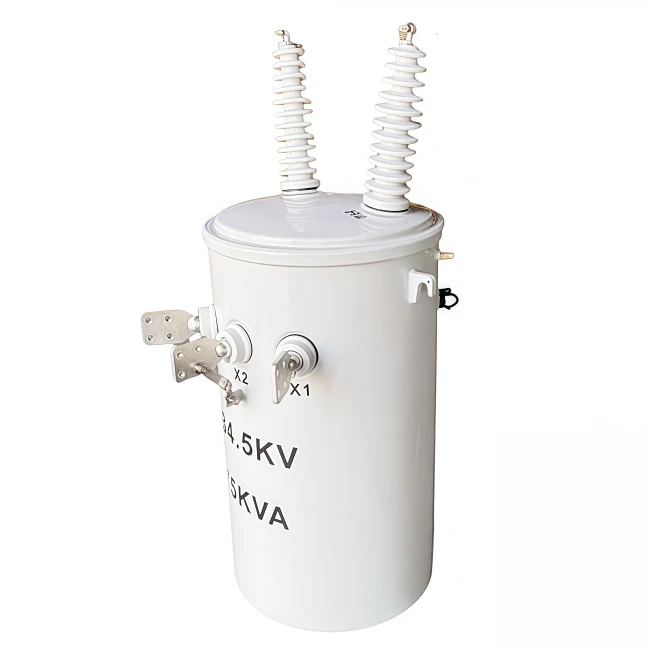
Importance of No - Load Testing for Our Products
As a supplier of Single Phase Pole Mounted Distribution Transformer, we conduct thorough no - load tests on all our products before they are shipped to our customers. This ensures that our transformers meet the highest quality and performance standards. By providing accurate data on core losses and magnetizing current, we enable our customers to make informed decisions about the energy efficiency and reliability of our transformers.
Applications of No - Load Testing Results
- Energy Efficiency Assessment: The core losses determined from the no - load test are a significant factor in the overall energy efficiency of the transformer. By knowing the core losses, customers can estimate the long - term energy consumption of the transformer and make decisions about energy - saving measures.
- Transformer Sizing: The magnetizing current information is crucial for sizing the protective devices and the electrical system. A high magnetizing current may require larger circuit breakers or fuses to ensure safe operation.
Conclusion
Performing a no - load test on a single phase pole mounted transformer is a vital step in ensuring its proper functioning and energy efficiency. By following the steps outlined in this blog post, you can accurately measure the core losses and magnetizing current of the transformer. As a supplier of high - quality Single Phase Pole Mounted Transformers, we are committed to providing our customers with reliable and efficient products. If you are in the market for a 75 Kva Pole Mounted Transformer or an Overhead Pole - mounted Single - phase Transformer, we encourage you to contact us for further details and to discuss your procurement needs. Our team of experts is ready to assist you in finding the best transformer solution for your specific requirements.
References
- Electrical Power Systems Design and Analysis textbook.
- IEEE Standards for Transformer Testing.