

Hey there! As a supplier of pole mounted distribution transformers, I often get asked about the rated currents of these transformers. So, I thought I'd write a blog post to shed some light on this topic.

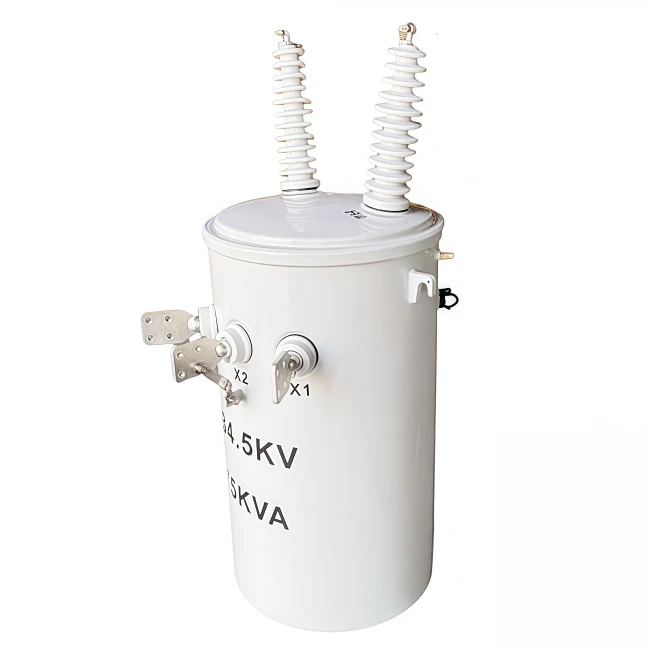
First off, let's quickly go over what a pole mounted distribution transformer is. These transformers are typically installed on utility poles and are used to step down the high - voltage electricity from the power grid to a lower voltage that can be used in homes and small businesses. They're a crucial part of the electrical distribution system.
Now, onto the rated currents. The rated current of a pole mounted distribution transformer is basically the maximum current that the transformer can carry continuously under normal operating conditions. It's an important parameter because if you exceed this current, it can lead to overheating, which can damage the transformer and even cause a power outage.
The rated current of a transformer is determined by its kVA (kilovolt - ampere) rating. The formula to calculate the rated current for a single - phase transformer is (I=\frac{S}{V}), where (I) is the current in amperes, (S) is the apparent power in kVA, and (V) is the voltage in volts. For a three - phase transformer, the formula is (I = \frac{S}{\sqrt{3}V}).
Let's take a look at some common pole mounted distribution transformers and their rated currents.
For example, a 75 Kva Pole Mounted Transformer. Assume a single - phase system with a secondary voltage of 240 volts. Using the formula (I=\frac{S}{V}), we substitute (S = 75000) VA (since 75 kVA = 75000 VA) and (V = 240) volts. So, (I=\frac{75000}{240}=312.5) amperes. This means that this 75 kVA single - phase pole mounted transformer can handle a continuous current of 312.5 amperes at 240 volts.
Another common type is the 167 Kva Single Phase Pole Mounted Transformer. Again, using the single - phase formula with a 240 - volt secondary voltage. We have (S = 167000) VA. Then (I=\frac{167000}{240}\approx695.83) amperes. So, this transformer can handle a relatively higher continuous current compared to the 75 kVA one.
A 100 Kva Single Phase Pole Mounted Transformer is also quite popular. With a 240 - volt secondary voltage, using the formula (I=\frac{S}{V}) where (S = 100000) VA, we get (I=\frac{100000}{240}\approx416.67) amperes.
It's important to note that in real - world applications, the actual current flowing through the transformer may vary depending on the load. For instance, during peak hours when more electrical appliances are in use, the current may approach or even exceed the rated current for short periods. However, transformers are designed to handle some degree of overloading for short durations.
When choosing a pole mounted distribution transformer, it's crucial to accurately calculate the expected load current. This involves considering the types of loads (resistive, inductive, or capacitive) and their power requirements. For example, inductive loads like motors draw more current during startup compared to their normal operating current.
Also, environmental factors can affect the performance of the transformer and its rated current. High ambient temperatures can reduce the transformer's ability to dissipate heat, which means it may not be able to handle its full rated current. In such cases, derating may be required. Derating is the process of reducing the transformer's rated capacity to ensure safe operation under adverse conditions.
Maintenance is another key aspect. Regular inspections of the transformer, including checking for proper ventilation, oil levels (if it's an oil - filled transformer), and the integrity of the insulation, can help ensure that it operates at its rated current without issues.
As a supplier, we offer a wide range of pole mounted distribution transformers with different kVA ratings and corresponding rated currents. We understand that every customer's needs are unique, whether it's for a small residential area or a commercial complex. Our team of experts can help you select the right transformer based on your specific load requirements and operating conditions.
If you're in the market for a pole mounted distribution transformer and need to figure out the right rated current for your application, don't hesitate to reach out. We're here to assist you in making an informed decision and ensuring that you get a reliable and efficient transformer for your electrical distribution needs.
In conclusion, understanding the rated currents of pole mounted distribution transformers is essential for proper selection, installation, and operation. By knowing how to calculate the rated current based on the kVA rating and voltage, and considering factors like load type, environmental conditions, and maintenance, you can ensure the long - term performance of your electrical system.
So, if you're looking to purchase a pole mounted distribution transformer, give us a shout. We'll work with you to find the perfect fit for your project.
References
- Electrical Power Systems: Analysis and Design by J. Duncan Glover, Mulukutla S. Sarma, and Thomas J. Overbye
- Handbook of Transformer Technology: Design and Application by George W. T. Anderson