


Aluminum vs Copper Coils for Distribution Transformers
Trying to decide between copper and aluminum coils for your transformer project? We break down energy performance, overall expense, unit mass, mechanical robustness and service longevity to help you pick the optimal winding material for your operational needs.
For decades, copper was considered the default option for transformer windings. But for the past thirty years now, aluminum has become the dominant choice. This isn't by accident. Modern aluminum-wound distribution transformers have proven to be just as reliable, efficient, and durable as their copper counterparts in real-world service.
That doesn't mean copper is the wrong choice. In fact, in certain applications, copper makes more sense. For power class substation transformers, copper is the go-to option. But for most commercial and industrial pad mounted transformers, dry-type transformers, and substation transformers, aluminum is not a compromise. It's usually more practical.
Comparing Copper and Aluminum Windings
|
Material |
Efficiency |
Size and Weight |
Cost |
Strength |
Manufacturing and Connections |
Life Expectancy |
|
Copper |
Higher |
Heavier and slightly smaller coils |
$$ |
Higher tensile strength |
Usually brazed connections, slight conductivity loss |
No direct effect on lifespan |
|
Aluminum |
Lower* |
Lighter and slightly larger coils |
$ |
Lower tensile strength |
Usually welded connections, no conductivity lost |
No direct effect on lifespan |
Efficiency
Energy performance ranks among the most critical factors to weigh while selecting raw materials for transformer windings.
Every modern distribution transformer, no matter if fitted with copper or aluminum coils, is engineered to comply with identical DOE efficiency regulations. As an illustration, local codes mandate all 500 kVA three-phase liquid-immersed pad-mounted transformers achieve an efficiency of 99.35%, with no differentiation based on winding metal.
Aluminum carries merely around 60 percent of copper's electrical conductivity. To offset this deficit, producers enlarge the cross-section of aluminum conductors, balancing the power loss levels to match those of copper windings.
Copper may be selected in projects demanding performance above DOE efficiency thresholds or ultra-tight loss limitations. Even so, the existing DOE 2016 specifications set unified efficiency benchmarks for all transformers rated below 2,500 kVA. Consequently, transformers built with either winding material deliver nearly equivalent energy efficiency.
Size and Weight
Coil Dimensions
When carrying out a transformer replacement for an aging model, its same-capacity replacement will likely feature larger overall dimensions. This shift mainly stems from the 2010-released DOE energy efficiency mandates. For retrofit projects constrained by limited installation space, copper windings present a viable solution thanks to their more compact geometry. Smaller copper coils can slightly cut down the overall dimensions of the transformer tank, though this solution falls under custom-engineered designs. Even with the extra expense for a bespoke transformer, the cost can be offset by avoiding full-scale overhauls of your existing installation layout.
Transformer Tank Footprint
Transformer suppliers generally adopt standardized tank housings as standard production. Therefore, choosing copper coil configurations will not automatically yield a more compact transformer. Manufacturers frequently deploy identical tank casings for both copper and aluminum wound variants. If minimizing the unit's floor space is a key priority, clearly communicate this requirement to your supplier upfront, as a custom-sized tank housing will likely be necessary.
Weight Considerations
Even with coils of identical dimensions, aluminum and copper windings create transformers with vastly different weights. Copper boasts a much higher density, resulting in copper-wound transformers that weigh approximately 20 percent more than their aluminum counterparts. For transformers mounted on rooftops or raised platforms, this added mass brings extra expenses and stricter structural reinforcement requirements.
On the other hand, copper-wound transformers remain the superior choice for projects where compact dimensions take precedence over light overall weight.

Cost
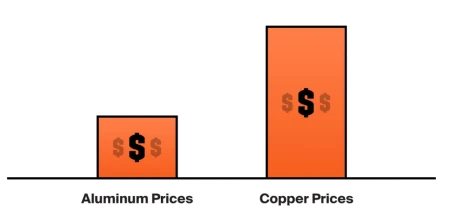
Copper commands a much higher raw material price and exhibits far greater price fluctuation compared to aluminum. As a result, transformers built with copper windings often carry a price tag two to three times that of aluminum-wound equivalents. For clients purchasing multiple transformers across various projects, this substantial upfront price gap accumulates rapidly.
That said, copper coils deliver superior energy efficiency, which translates to lower ongoing operational expenses over the equipment's service life. When a transformer is engineered to surpass DOE efficiency benchmarks, the cumulative long-term savings on running costs can be substantial. Even so, our calculations show it will take many years to offset the initial price disparity between the two winding types. Both short-term expenditure and long-term operational savings must be weighed carefully during material selection.
Tensile Strength
Tensile strength is a material's resistance to being pulled apart. Basically, how tough it is. Copper's high tensile strength makes it ideal for big transformers.
Larger power transformers see higher inrush currents and short-circuit forces. These high current forces will cause some movement in the windings. For this reason, copper is the best choice for larger power transformers. The copper coils of these larger units are usually wound in a circular disc design. The disc design reinforces the coils against strong short circuit forces. Aluminum has to take a back seat to copper here, every time.
But, most smaller padmounts and substations don't use disc coils. They use rectangular designs with sheet-wound low voltage coils. Additionally, the high voltage windings are layered on top of these sheet windings.
This rectangular design helps reduce short-circuit forces at the windings. The mechanical stress gets spread across the entire surface of the winding. In turn, this minimizes the role of the conductor's tensile strength. However, this design becomes impractical at larger transformer ratings.
But, it's the ideal option in the distribution space. Most commercial and industrial three-phase applications below 5MVA use rectangular designs. In this arena, copper and aluminum are on the same playing field.

Our address
No. 69, Tongyu South Road, Hai 'an, Jiangsu Province, China
Phone Number
(86)-18906286396
(86)-18260596750
alec.xia@vkepower.com
sharpay.xia@vkepower.com