

Introduction
The tap changer is a key device for adjusting the output voltage of a transformer. Its core function is to change the transformer's turns ratio by switching to different tap positions, thereby achieving voltage regulation. This device is widely used in power systems to maintain grid voltage stability and meet power supply demands under various load conditions.
 Based on the operating method, tap changers are mainly categorized into two types: On-Load Tap Changers (OLTC) and Off-Load Tap Changers. The former can can perform voltage adjustment while the transformer is energized. They are suitable for scenarios that require continuous power supply. The latter must be switched when the transformer is completely de-energized. They are often used in situations where frequent voltage adjustment is not required.
Tap Position Settings & Step Size
Most tap changers are designed for multi-position regulation, typically offering adjustment ranges such as ±5% or ±10%. The voltage adjustment step size per position is usually between ±0.5% and ±1.5%.
The accuracy of voltage regulation is influenced by the following factors:
Tap Size Setting
A smaller tap size enables higher regulation accuracy.
Measurement Error
The precision of the voltage detection device affects the regulation outcome.
Mechanical Wear
Long-term use can cause changes in contact resistance.
Ambient Temperature
Temperature variations affect winding resistance, thereby influencing the voltage output

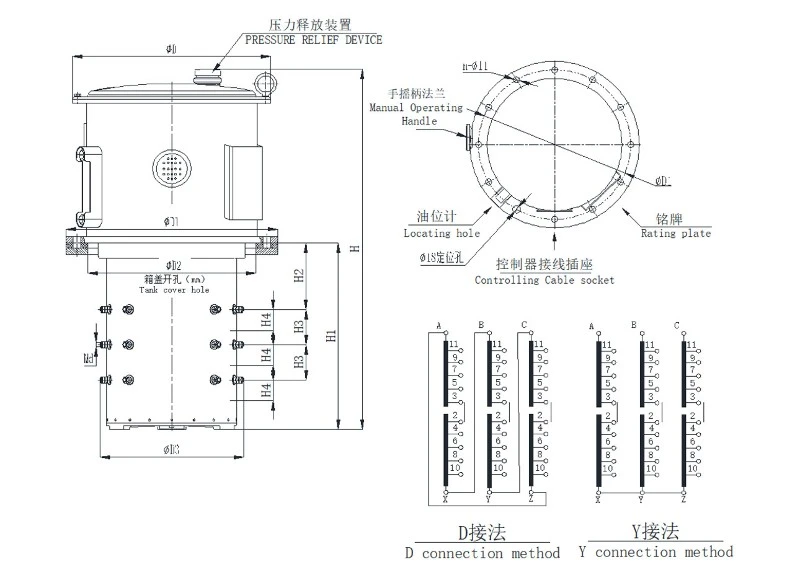
Mechanical tap changers regulate voltage by physically switching between different winding turns. Key components include switching contacts, a drive mechanism, a selector, and transition resistors.
Switching contacts are responsible for the physical transfer between different tap positions to ensure current continuity.
A drive mechanism is typically composed of gears, linkages, etc. It activates the selector and switching contacts.
A selector is used to choose the currently desired tap position.
Transition resistors are during the switching process to limit sudden current changes and prevent arcing.
Insulation framework supports the entire switch structure to ensure electrical isolation between components.
Electronic tap changers replace traditional mechanical contacts with power electronic devices, such as IGBTs, MOSFETs, and SCRs, to achieve non-contact switching. This design avoids issues like mechanical wear and arcing, thereby enhancing the equipment's stability and reliability.

Comparison Between Electronic and Mechanical Tap Changers
| Features | Electronic Tap Changer | Mechanical Tap Changer |
| Switching Speed | Extremely fast (microsecond level) | Slow (millisecond to second level) |
| Service Life | Nearly wear-free | Prone to wear, requires periodic maintenance |
| Switching Process | No arcing or mechanical shock | Involves arcing and mechanical shock |
| Control Precision | High, capable of closed-loop control | Relatively low, depends on mechanical positions |
| Cost | Higher initial cost | Lower initial cost |
| Cooling Requirement | High, requires a dedicated cooling system | Generally requires no specialized cooling |
Development Trends
Intelligent & Digital Design
New-generation tap changers integrate sensors and communication modules, supporting remote monitoring and control:
Integrated temperature sensors for real-time monitoring of switch temperature rise.
Support for communication protocols such as Modbus RTU for interfacing with SCADA systems.
Built-in fault diagnosis algorithms to automatically identify abnormal switching operations.
New Materials & Structural Optimization
New materials are being introduced into tap changer manufacturing to enhance their performance:
Nano insulating materials can increase dielectric strength and reduce physical size.
High-conductivity copper alloys can reduce contact resistance and minimize heat generation.
Modular design facilitates rapid replacement and maintenance.
In the future, tap changers will gradually evolve towards Adaptive Voltage Regulation, Status Perception, and Remote Control. They are becoming critical intelligent components in smart substations.